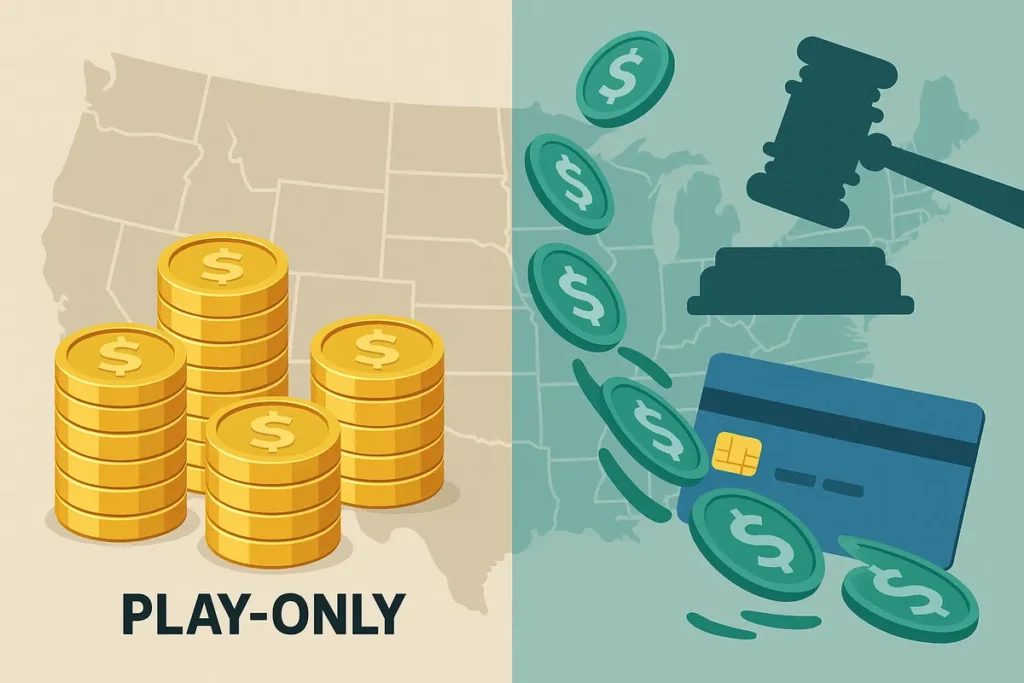



Buy a $10 gold coin package at a sweepstakes casino and the coins you paid for can never be turned into cash. The free sweeps coins bundled alongside them can. That single split is the entire legal foundation of the model, and it is exactly the claim regulators are now testing.
This is sweepstakes casinos explained from the mechanics up: what the two currencies actually do, why operators insist they are running promotions rather than gambling, and why Florida’s Attorney General has started leaning on the advertising layer instead of chasing the operators directly.
Sweepstakes casinos explained in one sentence
A sweepstakes casino is a website or app that offers slot, table and crash-style games for free using a play-only virtual currency, while running a parallel promotional sweepstakes with a second currency that can be redeemed for cash or prizes.
Nobody deposits money to bet, at least not on paper. You either play with the free currency for entertainment, or you enter the sweepstakes with the promotional currency and redeem any balance you build up. The games themselves are usually identical to what you would find at a licensed real-money casino, often supplied by studios you would recognise, running the same RNG logic and similar RTP figures. The wrapper around them is what differs.
Most of these operators are US-facing and geo-block the rest of the world, because the structure is built on American promotional law rather than gambling licensing. That matters for readers in India, and I will come back to it.
How the sweepstakes casino model works
Three pieces make the sweepstakes casino model function: two currencies, a no-purchase-necessary route, and a redemption process with identity checks at the end.
The dual currency system
Gold coins are the entertainment currency. Sweeps coins are the prize currency. Players buy gold coins the way they buy chips in a mobile game, and each purchase typically comes with free sweeps coins attached as a promotional bonus.
| Feature | Gold coins | Sweeps coins |
|---|---|---|
| How you get them | Purchased in packages, daily bonuses, promotions | Free with gold coin purchases, daily logins, social promos, mail-in entry |
| Can be bought directly | Yes | No |
| Cash value | None | Redeemable, commonly at a fixed rate |
| Purpose | Free-play entertainment | Sweepstakes entry and prize redemption |
| Withdrawable | No | Yes, after minimum threshold and verification |
Games run in one mode or the other. Switch to the sweeps coin mode and the same slot now pays out in a currency you can eventually cash out. This is the part critics fix on: the player experience is barely distinguishable from real-money virtual currency gambling, even though the accounting is structured as a promotion.
The no purchase necessary rule
US sweepstakes law treats a promotion as illegal gambling when three elements line up: consideration (you pay to enter), chance, and a prize. Take away consideration and, in the industry’s reading, you have a sweepstakes rather than a casino.
So operators build alternative ways to obtain sweeps coins without spending anything: daily login bonuses, social media giveaways, email promotions, and a postal mail-in entry route where you send a handwritten request to a listed address and receive free sweeps coins in return. Almost nobody uses the mail-in option. Its existence is what the legal argument hangs on.
Prize redemption process
Redemption usually runs like this:
- Accumulate sweeps coins above the site’s minimum redemption threshold.
- Meet any playthrough condition, such as playing each sweeps coin once before it becomes eligible.
- Submit a redemption request and complete KYC identity verification, typically ID plus proof of address.
- Receive the prize by bank transfer, e-wallet or gift card, subject to review.
Two things trip players up here. Sweeps coins won in gold coin mode do not exist, so mixing the modes wastes the redeemable balance. And redemption requests are reviewed, which means an account flagged for duplicate identities, VPN use or bonus abuse can have prizes denied under terms most people never read.
Sweepstakes casinos vs traditional online casinos
The gap is regulatory rather than experiential. A licensed online casino is authorised by a gambling regulator, pays gaming tax, files audited RTP reports and is bound by rules on advertising, affordability checks and self-exclusion. A social casino with a sweepstakes layer registers as a business, follows promotional sweepstakes law, and is supervised, if at all, by consumer protection authorities.
| Licensed online casino | Sweepstakes / social casino | |
|---|---|---|
| Money in | Real-money deposit, wagered directly | Purchase of virtual coins, free prize currency attached |
| Legal basis | Gambling licence in each jurisdiction | Promotional sweepstakes law, no gambling licence |
| Regulator | Gaming commission or equivalent | Usually none specific; consumer protection at most |
| Player protection tools | Mandated deposit limits, self-exclusion, reality checks | Voluntary and inconsistent |
| Game testing | Independent RNG and RTP certification required | Varies by operator |
| Gaming tax | Yes | No gaming tax; treated as retail sales |
| Dispute resolution | Regulator complaints channel | Operator terms, then the courts |
Neither column says anything about game fairness on its own. It says who you can complain to when something goes wrong, and how much of that is enforceable.
Why regulators are scrutinising the model
The most interesting recent development is not a lawsuit against an operator. Florida’s Attorney General has turned attention to the large technology platforms that carry sweepstakes casino advertising and distribution, as reported by trade outlet SBC Americas. The logic is straightforward: many of these operators are hard to reach, some are offshore, and the app stores, ad networks and social platforms are the chokepoint. Squeeze distribution and the model gets a lot harder to run.
The concerns behind that pressure fall into a few buckets:
- Advertising standards. Casino advertising rules in licensed markets cover age-gating, targeting and honest presentation of odds. Promotional sweepstakes ads sit outside those frameworks, so a slot game can be marketed as a free social game in feeds that reach anyone, including minors.
- Player protection. No mandated deposit caps, no regulator-backed self-exclusion register, no affordability checks. A player who spends heavily on coin packages has no statutory backstop.
- Consumer redress. When a redemption is refused, there is no gambling ombudsman. The dispute lives inside the operator’s terms of service.
- Tax and licensing parity. Licensed operators pay for the privilege of offering the same games; they have been vocal about competitors who do not.
Other US states have moved at different speeds. Some legislatures have passed explicit prohibitions, some attorneys general have issued cease-and-desist letters treating the model as unlicensed gambling, and many operators pre-emptively exclude residents of a handful of states in their own terms. The direction of travel is narrowing, not widening.
The industry’s counter-argument deserves a fair hearing. Operators say they run lawful promotions, that gold coin purchases are sales of entertainment content rather than wagers, that the free-entry route is real and available, and that KYC at redemption catches the abuse cases. Several have publicly asked for a licensing framework of their own rather than a ban.
The legal grey areas nobody has settled
Sweepstakes law was written for cereal-box contests and prize draws, not for a dual-currency virtual currency gambling product that runs thousands of spins a day. That mismatch is the grey area, and it produces a few genuinely unresolved questions.
Does bundling free sweeps coins with a paid purchase amount to consideration in substance, even if not in form? Courts in different states have treated similar questions differently, which is why the answer is jurisdictional rather than national. Does it matter that the overwhelming majority of a site’s revenue comes from coin packages bought by people playing the redeemable mode? Regulators think it does. Operators argue revenue source is irrelevant if entry is genuinely free.
Then there is the practical compliance layer: payment processors quietly withdrawing, app stores changing policies, geo-blocking that is only as good as the VPN detection behind it. Compliance here is a moving target rather than a fixed checklist, and an operator can be legal in one state on Monday and unavailable there by Friday.
What this means for players, including in India
If you are reading about free to play casinos from India, the first thing to understand is that this model is not built for you. Sweepstakes operators are structured around US promotional law and typically restrict access to US and Canadian residents, with more states dropping off the eligible list. Using a VPN to get around a geo-block breaches the terms you accepted, and the usual consequence is a denied redemption after verification fails.
The Indian legal picture is moving in a different direction entirely. Real-money online gaming has been tightened rather than loosened, and any site pitching a sweeps-coin structure to Indian players should be treated with suspicion rather than curiosity. For background, see our explainers on online casino legality in India and gambling advertising rules.
For anyone assessing an operator in a market where the model is permitted, the useful checks are unglamorous:
- Read the sweepstakes rules, not the homepage. Eligibility, minimum redemption, playthrough conditions and the mail-in address should all be stated plainly.
- Confirm your jurisdiction is listed as eligible before spending anything.
- Check who supplies the games and whether RNG testing is disclosed.
- Look for a stated redemption timeframe and a documented KYC process, then search for recent reports of payment delays.
- Accept that gold coins are a purchase with no resale value. Treat that spend the way you would treat a cinema ticket, not an investment.
The house edge does not disappear because the currency is virtual. These games carry the same built-in mathematical advantage as their real-money counterparts, and over time that edge is what funds the operator. If your play stops feeling like entertainment, set a spend limit, use whatever cool-off tools the site offers, and contact a support service in your country.
Frequently asked questions
How do sweepstakes casinos work?
You play casino-style games with gold coins, which have no cash value, or with sweeps coins, which are given away free alongside coin purchases and promotions and can be redeemed for prizes after verification. The free-entry route is what separates the model from licensed gambling in legal terms.
Are sweepstakes casinos legal?
It depends entirely on jurisdiction. In parts of the US they operate under promotional sweepstakes law without a gambling licence; several states have banned them or declared them unlicensed gambling. They are not a legal route into real-money play from India, and most block access from outside North America.
Why are regulators targeting sweepstakes casinos?
Because the product looks and plays like a casino while sitting outside gambling advertising rules, player protection mandates and gaming tax. Florida’s Attorney General has gone further than most by pressing the technology platforms that distribute and advertise these sites.
Is a social casino the same thing?
Not quite. A pure social casino offers free games with no prize redemption at all. A sweepstakes casino adds the redeemable second currency, and that redemption is what draws regulatory attention.




Leave a Reply