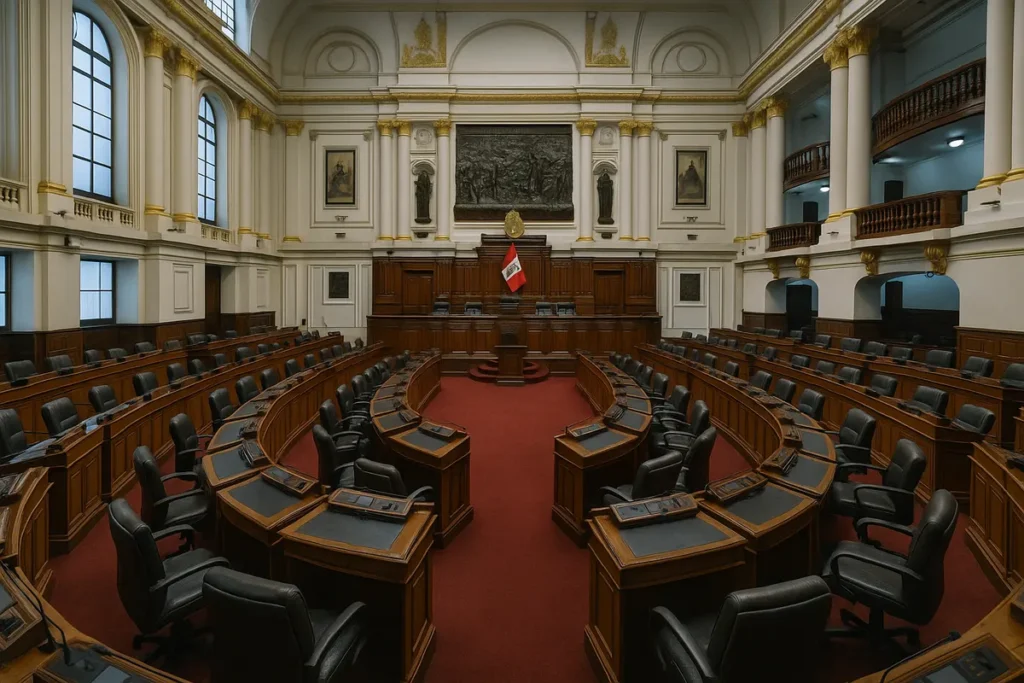



Myth: the Executive’s veto killed Peru’s online gaming tax fix
It didn’t. On 28 September 2026 the Chamber of Deputies confirmed it will process the same autógrafa de ley that the Executive observed back in July 2025, the one that rewrites how the Impuesto Selectivo al Consumo (ISC) is applied to bets placed on online gaming platforms. The story behind the 110879 Peru La Camara De Diputados headline is not a new bill. It is an old one that refused to die, and anyone who wrote it off last year now has a file number to deal with.
That file number matters: N°00389/2026-2031-CD. The Chamber invoked the Second Complementary Transitory Provision of the Congress Regulations, which governs how autographs observed by the Executive are handled, and assigned the text a fresh legislative proposal number so it can move as a new proposition. The document is signed by the Lower Chamber’s oficial mayor, Hugo Rovira.
What the 110879 Peru La Camara De Diputados file actually contains
Two things, bundled together, which is part of why it has had such a messy life:
- ISC mechanics for online betting. The text changes how the selective consumption tax is applied to wagers made on national and foreign iGaming platforms, and it would let the Ministry of Economy and Finance (MEF) move ISC rates within a band running from 0.3% to 7%, covering both remote games and remote sports betting.
- Match-fixing as a crime. The same initiative typifies the fixing or manipulation of sporting results as a criminal offence.
The paper trail is short but instructive:
| When | What happened | Status of the text |
|---|---|---|
| July 2025 | The Executive observed the autograph approved by Congress | Returned to Parliament |
| June 2026 | Shelved before the incoming legislators took their seats | Archived |
| 28 September 2026 | Chamber of Deputies takes it up again under the Congress Regulations | Live as N°00389/2026-2031-CD |
Myth: it’s a tax hike, plain and simple
That framing is lazy. The headline change is about application and flexibility, not a single new percentage. Correcting how the ISC is applied to online wagers is a technical fix with real money attached, because when the tax base and the trigger point are ambiguous, operators either over-provision or under-collect, and the tax authority ends up arguing about it later.
The part that should get commercial teams’ attention is the 0.3%-7% band. A ceiling more than twenty times the floor is not a number, it is a range of business models. A remote sports betting book priced around a low single-digit turnover tax and one priced near 7% of wagers are not the same company: margins on high-turnover, low-hold products such as live football markets get squeezed hardest by a turnover-style levy, because the tax lands on volume rather than on what the operator actually keeps. That is on top of Peru’s separate tax on net gaming revenue and the standard licensing costs under MINCETUR’s regime.
Myth: rate-setting by ministry is a harmless technicality
Delegating rate movement inside a legislated band is common in tax design, and it does give the MEF a lever it can pull without waiting for a new law. The flip side is that operators lose the comfort of a rate that can only change through a full legislative cycle. If this passes as drafted, the planning question stops being “will Congress raise the tax?” and becomes “where in the band will the ministry sit next fiscal year?”
Anyone building a five-year P&L for Peru should model the ceiling, not the floor. Not because a 7% rate is announced, forecast or promised, but because a band exists precisely so it can be used.
Myth: offshore platforms can sit this one out
The text explicitly reaches bets made on foreign platforms as well as national ones. That is the direction of travel across the region: tax the wager wherever the operator is domiciled, and lean on the licensing regime and payment rails to make it stick. For unlicensed operators still serving Peruvian players, a clarified ISC application is one more reason the grey route gets more expensive and more legally exposed, not less.
Myth: the match-fixing clause is padding
It is the quietest part of the file and arguably the most consequential for the betting product. Criminalising the manipulation of sporting results gives integrity units, federations and regulators something to escalate to beyond disciplinary sanctions. For sportsbooks it changes the calculus on suspicious betting alerts in Peruvian competitions: reports can feed a criminal process rather than disappearing into an administrative one. That tends to improve cooperation in both directions, and it is the kind of provision that makes a market easier for international operators to underwrite.
Myth: a new number means a clean-slate debate
No. The substance already cleared Congress once, which is why it existed as an autograph in the first place. What changed is the political room around it: it was observed by the previous government, archived before the new legislature arrived, and is now being revived inside Peru’s two-chamber Congress with a 2026-2031 file reference. The arguments have been rehearsed. The question is whether the Chamber of Deputies insists on the original text, negotiates the band downward, or unbundles the criminal provision from the tax one.
The practical read for operators and suppliers
Three things worth doing while the file moves rather than after it lands:
- Re-run pricing at the top of the band. Stress-test turnover-heavy verticals, not just the blended number. A crash game or a live in-play football book behaves very differently under a wager-based tax than a slots portfolio.
- Check your tax base assumptions against the corrected mechanics. If your Peru model was built on an interpretation the Executive disputed in 2025, it needs revisiting.
- Tighten integrity reporting now. If manipulation of results becomes a criminal offence, the quality of your suspicious-activity records stops being an internal matter.

Leave a Reply