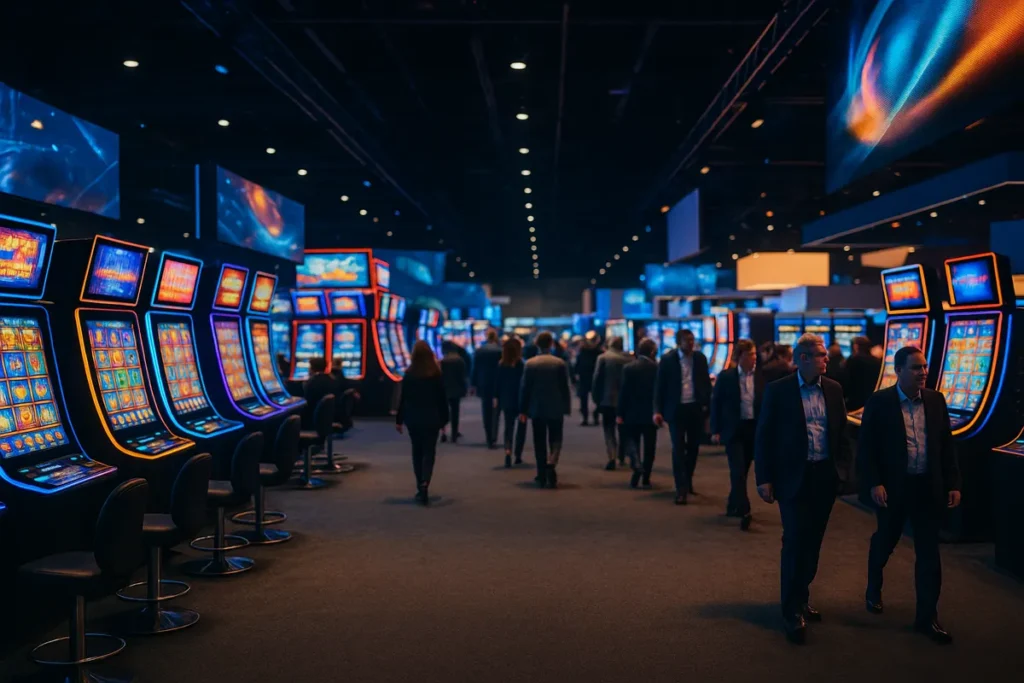
Four days and one booth number, 4455. That is the entire stage IGT has given itself to launch a new corporate identity in front of the people who decide which games end up on casino floors and in online lobbies for the next few years. The company confirmed it will unveil the refreshed brand at the Global Gaming Expo in Las Vegas, the 2026 show running Sept. 28 to Oct. 1.
If you play slots or live dealer tables, a supplier changing its logo sounds like the least relevant news imaginable. It isn’t, quite. The g2e gaming expo is where the machines and mechanics you’ll be playing in twelve months get shown to buyers, and the language a company chooses to describe itself there is usually a fairly honest preview of what it intends to build. Worth unpacking properly.
What exactly is IGT announcing?
A new brand identity, positioned around what the company calls being “fluid, frictionless and magnetic.” IGT describes it as the next chapter in its evolution and a deliberate move away from a traditional corporate look toward something bolder and more modern.
The identity is organised around four areas: integrated solutions across the casino floor, in-demand games built to bring players back, expertise drawn from operating experience, and a stated commitment to customer success. IGT also says the new brand is meant to support connected player experiences through its FinTech and systems businesses, alongside game content for both land-based casinos and online.
Hector Fernandez, IGT’s CEO, framed it this way: “At G2E, our customers will see and feel the IGT transformation story in motion. Our new brand identity signals who we are becoming and how our culture, capabilities and content are propelling us forward.” He added that the goal is to give operators a “connected ecosystem with magnetic content that will excite players and drive performance.”
Note who the customer is in that sentence. Operators. The rebrand is a sales message aimed at casino and sportsbook buyers, not at the person spinning the reels. That distinction matters for how you read it.
Why should a player care about an IGT rebrand at all?
Because the vocabulary suppliers use at a gaming technology conference tends to become the product a year or two later. Strip the marketing off “fluid, frictionless and magnetic” and you get three concrete engineering priorities:
- Fluid generally means one account, one wallet, one identity moving between a physical casino and its app. Cashless play, loyalty points that follow you, a game you start on a cabinet and continue on your phone.
- Frictionless is payments and onboarding. Faster deposits, fewer re-verification steps, quicker cashouts. That is the FinTech and systems side of the business, and it is the part players actually feel most often.
- Magnetic is retention language. Games designed so sessions run longer and players return, which is where mechanics like linked jackpots, hold-and-spin features, persistent state and tiered free spins come from.
Two of those three are genuinely good for you. The third is worth reading with your eyes open, and I’ll come back to it.
Does a new identity change the games themselves?
No. This is the part that gets muddled in coverage of supplier news. A rebrand changes logos, booth design, positioning decks and sometimes internal structure. It does not change the maths inside a game.
A slot’s RTP, its volatility profile and its hit frequency are set in the game’s own configuration and certified by test labs, then often offered to operators in several RTP settings. A 96% RTP game returns roughly ₹96 per ₹100 wagered averaged over millions of rounds, leaving a 4% house edge, and that figure is unaffected by what the supplier’s letterhead looks like. Outcomes still come from an RNG, each round independent of the last. If a company tells you its new identity makes games more exciting, it is talking about art, sound, feature design and how the cabinet or lobby tile looks, all of which are real craft, and none of which alter the edge.
Is a rebrand a sign of strength or a sign of trouble?
Honestly, it can be either, and the tell is what sits underneath it. Suppliers refresh identities for a handful of reasons: a merger or acquisition that needs a single face, a strategy shift from hardware into content and systems, a push into new regulated markets, or simply a logo that has aged badly.
IGT’s own framing points at consolidation of its offering into one connected stack rather than separate hardware, systems and content pitches. The four pillars read like a company that wants to be bought as a platform, not as a shelf of individual products. That is a fair summary of where a lot of the sector is heading. The big slot provider brands increasingly sell an ecosystem, while the interesting mechanical experimentation comes from smaller studios that can afford to ship something odd.
What does the expo calendar actually reveal about next year’s games?
Trade shows are the industry’s release schedule in disguise. The pattern is consistent enough to be useful:
| What you see at the expo | What reaches players later |
|---|---|
| New cabinet hardware and screen formats | Land-based exclusives, later ported to online with different art |
| Cashless wallet and FinTech demos | Faster deposits, KYC-linked accounts, single-balance play |
| Licensed IP announcements (film, TV, music) | Branded slot releases across the following year |
| Jackpot network launches | Progressive pools shared across venues or operators |
| Studio partnerships and content deals | New casino game providers appearing in your lobby’s filter list |
That last row is the one most players notice first. When a supplier signs aggregation or distribution deals at a show, unfamiliar studio names start turning up in online casino lobbies months afterwards. If you have ever wondered why a dozen new providers appeared in your filter menu at once, the answer is usually a contract signed on a trade show floor.
How should you read expo news without getting sold to?
A few habits that keep this kind of story useful rather than promotional:
- Separate the pitch from the product. “Magnetic content” is a claim about engagement, not about value returned to players. Check the game’s published RTP and volatility when it launches, not the press release.
- Treat retention features as what they are. Persistent progress bars, collection meters and near-miss style visuals are designed to keep sessions going. Enjoy them if you like them, but recognise the intent.
- Watch the payments announcements. This is where genuine player benefit hides. Faster withdrawals and cleaner verification are the least glamorous and most valuable things announced at any gaming technology conference.
- Check the operator, not just the logo. A well-known supplier’s games appearing on a site tells you something about content licensing, not about whether that site holds a licence you can trust or pays out reliably.
The broader read on industry direction
Taken together with the wider set of iGaming industry trends visible at this show cycle, IGT’s repositioning fits a clear direction: fewer standalone products, more connected accounts, and content judged on how well it holds an audience rather than how novel its mechanic is. For players that means smoother money movement, more crossover between venue and app, and games engineered with retention in mind from the first design meeting.
None of which changes the arithmetic. Every game on that expo floor, in every booth, carries a house edge, and over time that edge is what pays for the booth. Set a deposit limit, treat the money as entertainment spend rather than an investment, and use the cool-off and self-exclusion tools your operator is required to offer if play stops feeling like a choice. If you want to verify any of the above, IGT’s announcement and the show schedule are published by IGT and the Global Gaming Expo respectively.

Leave a Reply