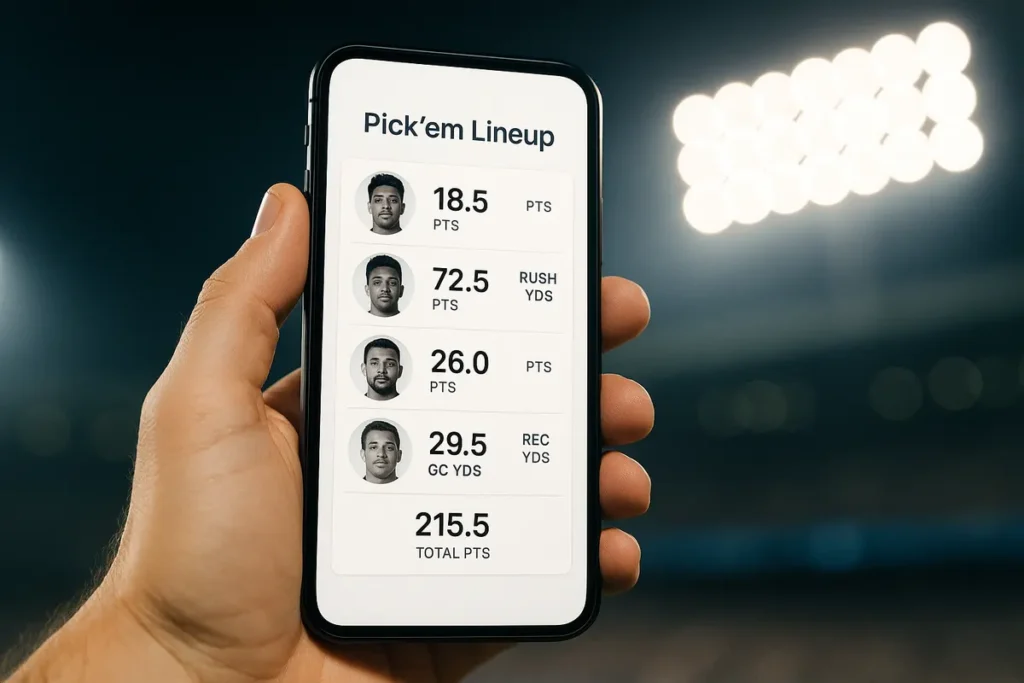



Fourth quarter, under two minutes. Your tight end needs nine more receiving yards, the game total is sitting one point shy of your over, and both of those picks are sitting on the same slip. That combination is new. PrizePicks has rolled out multi-athlete and multi-team combo picks, which means for the first time you can build a single lineup that mixes traditional more-or-less stat projections with game winners, point spreads and totals.
If you have never used a pick’em product, here is the short version: the PrizePicks multi athlete format widens what can go into one entry, and every extra selection you add makes the entry harder to win while paying more if it lands. That trade-off is the whole story. Everything else is interface.
What actually changed in the app
Three things arrived together, timed for the football season.
- Combo lineups. One entry can now hold more-or-less picks on several athletes’ stat projections plus predictions on game results, including winners, spreads and totals. You can also stack multiple game outcomes inside a single entry.
- Live game data. Real-time updates, box scores and a play-by-play feed sit inside the app, so you track your lineup while the game runs instead of tabbing between apps.
- Reboot, pushed harder. PrizePicks says it will amplify its Reboot policy across the season. If an athlete is injured in the first half and does not return, the pick is marked DNP and the rest of your lineup stays alive.
Dylan Cooper, SVP of Product at PrizePicks, framed the release as part of a continuous build rather than an annual refresh, saying the company has been “heads-down building new ways to make the PrizePicks platform even more engaging.” Read past the language and the product direction is clear: keep the user inside one app for the full three hours of a game.
How a combo lineup settles
Mechanically it is still pick’em. You choose a set of selections, each one resolves higher or lower than the posted line (or right or wrong on a game result), and the entry pays according to a fixed payout table based on how many selections you made and which entry type you used.
PrizePicks has long offered two shapes of entry. On an all-or-nothing entry, every selection has to hit. On a flex-style entry, you can miss one and still collect a reduced payout. The combo format does not change that logic, it just widens the menu of things you can put in the slip.
Worth naming plainly: mixing player props with spreads and totals in one entry looks and behaves a lot like a same-game parlay. The regulatory wrapper is different, because these are offered as daily fantasy sports contests rather than sportsbook bets, and that distinction is exactly why pick’em products are available in some US states and not others. Check what is actually offered where you are before you plan around it.
The math you should run before you tap submit
Every selection you add multiplies your risk of a miss. The table below assumes each selection is independent and shows what the combined chance of a clean entry looks like at two per-pick hit rates. Fifty percent is a genuine coin flip. Fifty-five percent is what a sharp, disciplined player might sustain on a good run of lines.
| Selections in the entry | Chance all hit at 50% per pick | Chance all hit at 55% per pick |
|---|---|---|
| 2 | 25% | 30.3% |
| 3 | 12.5% | 16.6% |
| 4 | 6.3% | 9.2% |
| 5 | 3.1% | 5.0% |
| 6 | 1.6% | 2.8% |
Those numbers are illustrative, not a forecast of your results. But they make the point that the big six-pick payouts everyone screenshots are rare by construction, not by bad luck. And note the shape of the curve: a two point improvement in your per-pick accuracy barely rescues a six-leg entry.
Two more honest caveats. First, independence is an assumption, and combo lineups break it. If you take a quarterback’s passing yards over and the game total over in the same matchup, those outcomes move together, so the real probability sits above the simple multiplication when the game goes your way and below it when the game turns into a run-heavy slog. Correlation fattens both tails. Second, the payout attached to each entry size is set by the operator and sits below what genuinely fair odds would pay for that probability. That gap is the built-in margin, the same concept as the overround in a sportsbook price or the house edge in a casino game. It is why the operator profits across millions of entries, and no selection strategy removes it.
Reboot changes the risk profile more than it looks
Injury voids are the quietly important part of this release. In a six-selection entry, one player pulling up lame on the opening drive used to be the end of the whole thing. Marking that athlete DNP so the remaining selections play on removes a chunk of variance that had nothing to do with your read on the matchup.
Do not over-extend it in your head. The policy as described covers an athlete injured in the first half who does not return. A player who takes the field, plays through the third quarter and then limps off with two catches is not a Reboot case, he is just a bad result. Read the current policy terms in the app before you build around it, because the details of these rules are what decide whether an entry voids or graves.
Where multi-entry play gets expensive
The natural response to low combined probabilities is to fire more entries. Ten variations on the same core lineup feels like diversification. Usually it is the opposite, because the entries share legs and fail together. If your anchor pick misses, all ten slips die at once, and you have paid ten times for a single opinion.
If you are going to play multiple entries, a few habits keep it sane:
- Set the total you are willing to spend for the day before you open the app, and treat it as the cost of entertainment, not an investment.
- Count unique opinions, not unique slips. Five entries built on the same two anchors is roughly one bet.
- Decide your entry size on purpose. Shorter entries win far more often and pay far less; long entries are lottery-shaped.
- Use the app’s deposit and spend limits. Live box scores and a play-by-play feed make chasing easier, and that is precisely when limits earn their keep.
The bigger read on this release
For the industry, the combo format is another step in pick’em products converging on the feel of a sportsbook slip while staying inside the fantasy framework. Adding game winners, spreads and totals to an athlete-based entry expands the addressable market for a company whose core audience already understands parlays. Adding live data and a play-by-play feed is a retention play, keeping engagement inside the app for the whole broadcast rather than for the 90 seconds it takes to build a lineup.
For you, the practical upshot is narrower. More selection types means more ways to construct an entry, more correlated legs to think through, and more temptation to stretch a lineup to six picks because the payout number looks good. The format is genuinely more flexible. The arithmetic underneath it has not softened.
Play for entertainment, only with money you can afford to lose, and use deposit limits, cool-off periods and self-exclusion tools if play stops feeling like play. In the US, the National Council on Problem Gambling helpline (1-800-522-4700) is free, confidential and available 24/7. Age restrictions apply and vary by state.

Leave a Reply