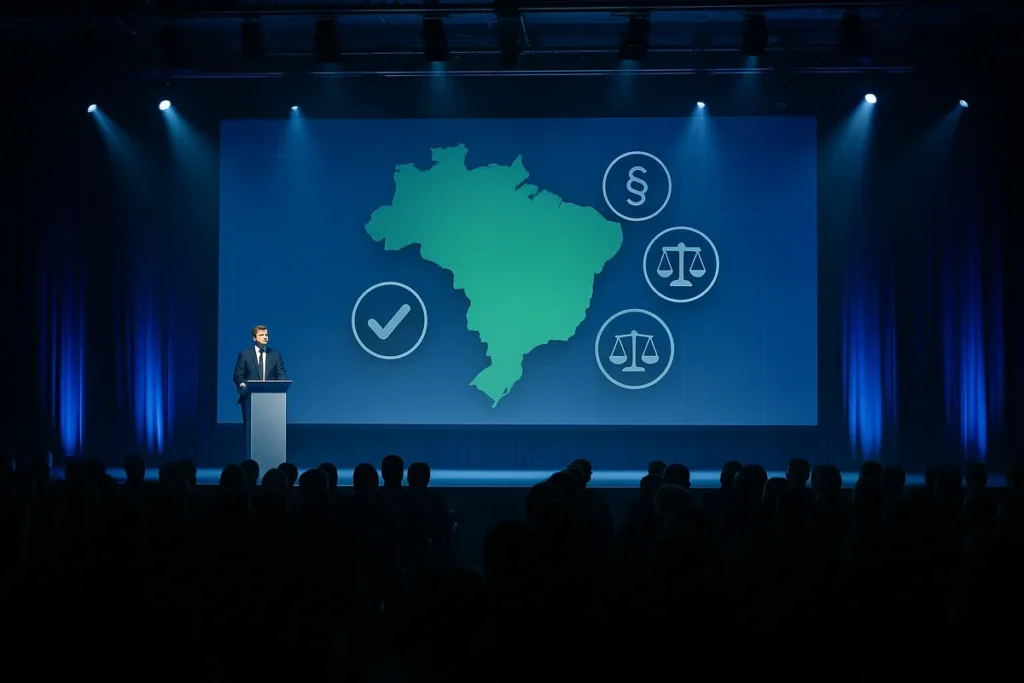


Somewhere between the coffee queue and the third panel of the morning, you could have run a drinking game on the word “Brazil.” Michael Jordan was the marquee name on the SBC Summit Lisbon 2026 bill, and he pulled the crowd he was always going to pull. But the conversation that followed people out of the halls and into the bars was less glamorous: what Brazil is doing to its betting market, how far it goes, and which market copies it next.
So let’s start with the question everyone actually wants answered.
Has Brazil actually banned betting?
No. There is no blanket Brazil betting ban. Brazil legalised fixed-odds sports betting and online casino games under Law 14.790/2023, and the licensed market went live on 1 January 2025 under the Prizes and Betting Secretariat (SPA) inside the Ministry of Finance. Dozens of operators paid to be there. The “ban” in the brazil betting ban debate refers to something narrower and messier: a growing stack of prohibitions inside a legal market, plus live political and legal pressure to go further.
That distinction matters, because the two things get flattened into the same headline constantly. A country that bans gambling outright and a country that bans credit card deposits, bans welfare recipients from betting, and bans certain advertising messages are in very different places commercially, even if both generate the word “ban.”
What is actually restricted in Brazil right now?
The Brazilian framework is unusually prescriptive for a newly opened market. The headline items:
- A federal licence costs R$30 million for a five-year term, covering up to three brands. That is a price designed to keep the small and the casual out.
- Licensees must be incorporated in Brazil, with a Brazilian partner holding a meaningful minimum stake in the company.
- Gross gaming revenue is taxed at 12%, with proposals to push it higher recurring in Brasília with some regularity.
- Deposits must come from an account in the player’s own name. Credit cards are out. Crypto is out.
- Beneficiaries of the Bolsa Família social welfare programme are barred from betting.
- Identity verification is mandatory and strict, with biometric checks built into the onboarding rules.
- Advertising content rules prohibit framing betting as a route to income, wealth or social advancement, and bar marketing aimed at minors.
Layered on top of that: a Senate inquiry into the sector spent much of its life recommending far tighter controls, advertising among them, and the legal framework itself has been challenged before Brazil’s Supreme Federal Court. That combination, an expensive licence plus an unsettled rulebook, is exactly why Brazil dominated so much Lisbon conversation. Operators have already spent the money. They are now watching to see what they bought.
Why do governments clamp down on a market they just legalised?
Because legalisation makes the harm visible. Before regulation, betting activity in Brazil ran through offshore sites that filed no reports and answered to nobody. After regulation, there is data: deposit volumes, player numbers, complaint counts, and a very public debate about household spending among lower-income bettors. Politicians who voted for a tax base discover they also voted for a constituency of worried families.
The pattern repeats almost everywhere. Three pressures do the work:
- Visibility of harm. Licensed operators report. Reports become statistics. Statistics become front pages.
- Advertising saturation. New markets get loud fast, because acquisition is cheapest at the start. Loud markets annoy non-gamblers, who vote.
- Fiscal temptation. Once an industry is legal and profitable, raising its tax rate is politically cheap. Restrictions and tax rises tend to travel together.
None of this is Brazil-specific. What is Brazil-specific is the speed. Most markets take a decade to move from opening to clampdown. Brazil has compressed that into the first couple of years.
Is Brazil doing anything Europe hasn’t already tried?
Not really, and that was half the point of the Lisbon discussion. Europe has run most of these experiments already, which is why delegates kept reaching for comparisons. Here is the short version of who restricted what:
| Market | Headline restriction | Stated aim |
|---|---|---|
| Italy | Broad ban on gambling advertising and sponsorship (Dignity Decree, in force since 2019) | Reduce exposure, particularly for young people |
| Netherlands | Ban on untargeted gambling advertising from 2023, with sponsorship restrictions phased in after | Cut mass-market advertising reach |
| Belgium | Advertising ban from 2023, plus tightened deposit limits | Limit promotion and player spend |
| Germany | €1 maximum stake per online slot spin and monthly deposit caps under the 2021 interstate treaty | Reduce speed and size of losses |
| United Kingdom | Online slot stake limits introduced in 2025, lower for 18–24 year olds | Protect younger and higher-risk players |
| Brazil | Credit card and crypto deposit bans, welfare recipient exclusion, advertising content rules | Restrict borrowed and subsidised money entering betting |
Brazil’s approach is distinctive in one respect: it targets the source of funds rather than the shape of the game. Europe mostly capped stakes and muted marketing. Brazil went after the payment rail and the welfare payment. Whether that proves more effective is genuinely an open question, and one of the more interesting arguments doing the rounds in Lisbon.
What does a clampdown actually do to a market?
Three things, fairly reliably.
Channelisation slips. Every restriction that makes the licensed product worse relative to the offshore product pushes some demand offshore. Regulators in Europe track this closely, precisely because a licensed market that captures a shrinking share of play delivers less protection and less tax. Nobody in the industry disputes the mechanism, only its size.
Acquisition costs move. Ban advertising and you don’t remove marketing spend, you redirect it. Money shifts to affiliates, retention, CRM and whatever channels remain legal, and the big incumbents with existing databases gain relative to challengers who needed advertising to exist at all. Restriction is usually consolidation in disguise.
Product changes. Stake caps and deposit limits reshape what studios build. Germany’s €1 slot spin limit produced a genuinely different local product catalogue. Rules aimed at players end up rewriting supplier roadmaps.
What does it mean for players outside Brazil?
Practically, three things worth internalising.
First, regulatory regimes are converging on the same tools. If your market is newly regulated, look at Brazil’s list and assume some version of it is on a desk somewhere: deposit source restrictions, ID checks with real teeth, advertising content limits, and taxes that rise rather than fall.
Second, restrictions change your practical experience before they change the law. Payment methods quietly disappear. Verification requests arrive before a withdrawal clears rather than after signup. Bonus offers get smaller and the wagering requirements behind them get stricter, because the marketing budget that funded generous promotions is under pressure. None of that shows up as “a ban” in the news, but it is what a clampdown feels like from the account page.
Third, “banned” headlines are worth reading twice. A prohibition on one payment method, one product vertical or one advertising channel is not a market closure, and treating every restriction story as an exit signal is how people end up on unlicensed sites with no complaints process and no withdrawal guarantee. The licensed operator with fewer promotions is still the one that has to pay you.
What’s worth watching next?
Brazil’s unresolved items are the ones to track: whether the GGR tax rate moves, how far advertising rules tighten, and how the constitutional questions around the framework are ultimately settled. Each outcome will be cited by someone, somewhere, as precedent, because that is how gambling regulation has always travelled. Italy’s advertising ban has been quoted in parliamentary debates on three continents. Brazil’s payment restrictions will be next.
Which is the unspoken reason a Brazilian regulatory argument swallowed so much of a conference in Portugal. Nobody in that room thought it was only about Brazil.
If betting has stopped being entertainment and started being a way to chase money back, use the tools that exist: deposit and loss limits, session reminders, cool-off periods and self-exclusion. Every licensed operator is required to offer them, and national support services are free and confidential. Gambling carries a built-in house edge, which means the longer you play, the more the maths favours the operator. No restriction, and no strategy, changes that.

Leave a Reply