

A decree with the force of law, and a licence nobody is refunding
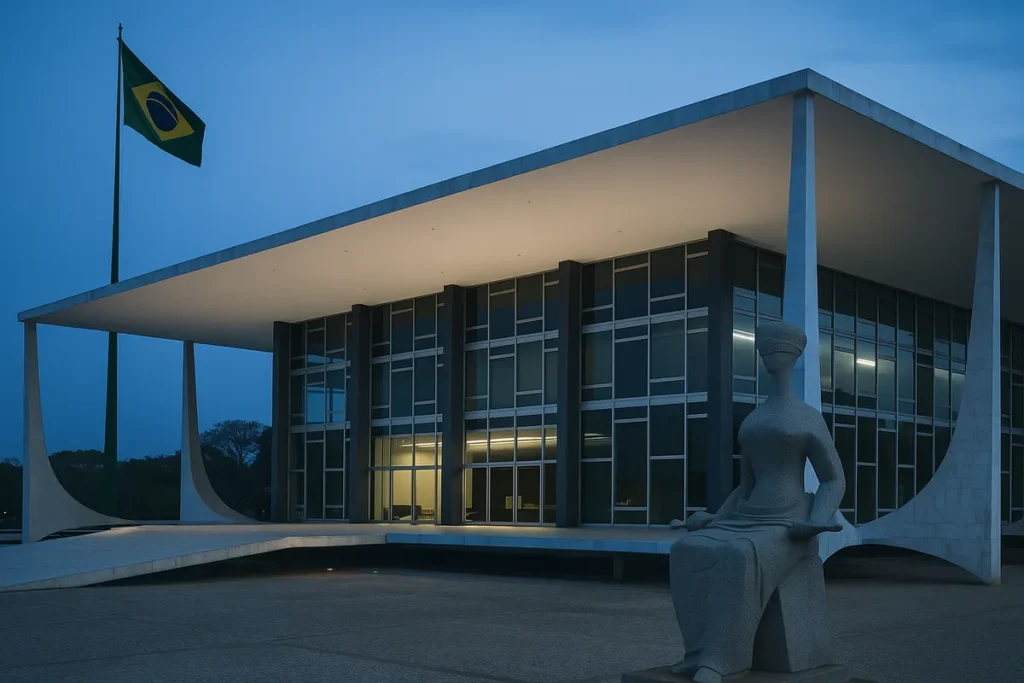
A medida provisória is a presidential decree that carries the force of law from the moment it is signed. That is the simple version. The complicated version is the one now sitting on a Supreme Federal Court desk in Brasília, filed under the headline “110882 Brasil: La ANJL y el IBJR inician acciones legales contra la prohibición de las apuestas” — because the decree in question does not amend the betting rules Congress passed and the President himself signed into law. It switches them off, tells licensed operators to stop taking deposits immediately, orders websites and apps dark from 6 October, and states plainly that the BRL 30 million each of them paid for a five-year licence will not be coming back.
That last clause is why this became a court case in three days rather than a lobbying campaign over three months.
What the 110882 Brasil La ANJL y IBJR filing actually asks
On Monday 28 September 2026, the Asociación Nacional de Juegos y Loterías (ANJL) and the Instituto Brasileño de Juego Responsable (IBJR) went to the Supremo Tribunal Federal seeking suspension of the provisional measure’s effects. Not its annulment on the merits, at least not first. Suspension. They want the clock stopped before 6 October, because the alternative is a market that shuts down while the constitutional question is still being argued.
The petition was addressed to Justice Luiz Fux, who is already rapporteur of three ações diretas de inconstitucionalidade concerning the betting sector before the court. Filing with the judge who holds the existing docket is a deliberate choice: it frames the ban not as a fresh dispute but as the latest move in a case he has been living with for some time.
Two arguments carry the weight. The first is institutional: a provisional measure cannot casually undo a framework debated and approved by Congress and sanctioned by the President who now signs the decree reversing it. The second is financial and, frankly, harder for the government to answer. Companies paid BRL 30 million each for authorisation to operate from 2025 through the end of 2029. The MP cancels the right and keeps the money.
The figures, in order
The timeline is short enough to be unnerving. Three days separate the signature from the lawsuit, and eight working days separate the signature from the shutdown deadline.
| Date | Event |
|---|---|
| Friday 25 September 2026 | President Lula signs the provisional measure banning online betting; new deposits and bets to halt immediately |
| Monday 28 September 2026 | ANJL and IBJR petition the STF, addressed to Justice Luiz Fux, seeking suspension of the MP’s effects |
| Tuesday 6 October 2026 | Date on which licensed sites and apps must cease functioning under the MP |
| 2025 to end of 2029 | Term of the operating licences already paid for, at BRL 30 million per company |
Multiply that licence fee by the number of authorised operators in Brazil and the retained sum runs into billions of reais. The associations are not arguing that the state lacks power to restrict gambling. They are arguing it cannot sell a five-year right, collect the cheque, and then withdraw the right by decree while declining to return the payment.
Why the procedural mechanics decide this
A provisional measure is a temporary instrument. Under the Brazilian constitution it requires relevance and urgency, takes effect on publication, and must be approved by Congress within 60 days — extendable once — or it lapses. So there are two ways this ends without the STF ruling on constitutionality at all: Congress lets it expire, or Congress converts it into ordinary law.
The problem for operators is that the damage is front-loaded. If sites go dark on 6 October and the measure later lapses in November, the market does not simply resume where it left off. Marketing contracts, sponsorship deals, payment integrations and staff are all gone by then. Hence the request for suspension rather than a patient wait for the legislature. Interim relief is the whole ballgame.
Worth noting what the court is not being asked to decide: whether online betting is good for Brazil. The filing is about legal certainty, the hierarchy of legal instruments, and money already paid to the treasury. Those are the arguments that tend to move judges.
What operators, suppliers and players face in practice
For licensed operators, the immediate work is contingency planning on two tracks at once: complying with a deposit and betting freeze that is already in force, and preparing to reopen if Fux grants a suspension. Both cost money, and neither can be skipped.
Suppliers feel it second-hand but no less sharply. Game studios, live casino providers, payment processors, affiliates and data feeds all price Brazil as a growth market. A regulated market that can be closed by decree, with fees non-refundable, changes the risk premium on every contract signed there, and on how seriously other Latin American licence regimes are taken.
For players, the practical points are unglamorous. Deposits and new bets on licensed platforms are stopped, and the MP sets 6 October for sites and apps to stop working, which puts questions about pending bets and account balances squarely on operators and the regulator to resolve. The predictable side effect of shutting a regulated market quickly is that demand migrates to unlicensed sites, where there is no local dispute route, no verified RNG certification and no enforceable deposit limit or self-exclusion register. Anyone who feels their play is becoming a problem should use self-exclusion and cool-off tools while they still have a licensed account to use them on, and contact a support service rather than an offshore replacement.
Questions readers are asking
Who filed, and against what?
ANJL and IBJR, two sector bodies, filed at the STF on 28 September 2026 against the provisional measure signed on 25 September 2026 that bans online betting in Brazil. They asked for the measure’s effects to be suspended.
Does the ban take effect before the court rules?
The freeze on new deposits and bets applied on signature, and the MP orders sites and apps to stop functioning from 6 October 2026. Unless a judicial suspension arrives first, the deadline stands.
Do operators get their BRL 30 million back?
Not under the MP as written. It states there will be no refund of the licence payment, which covered operation from 2025 to the end of 2029. That non-refund clause is central to the associations’ case.

Leave a Reply