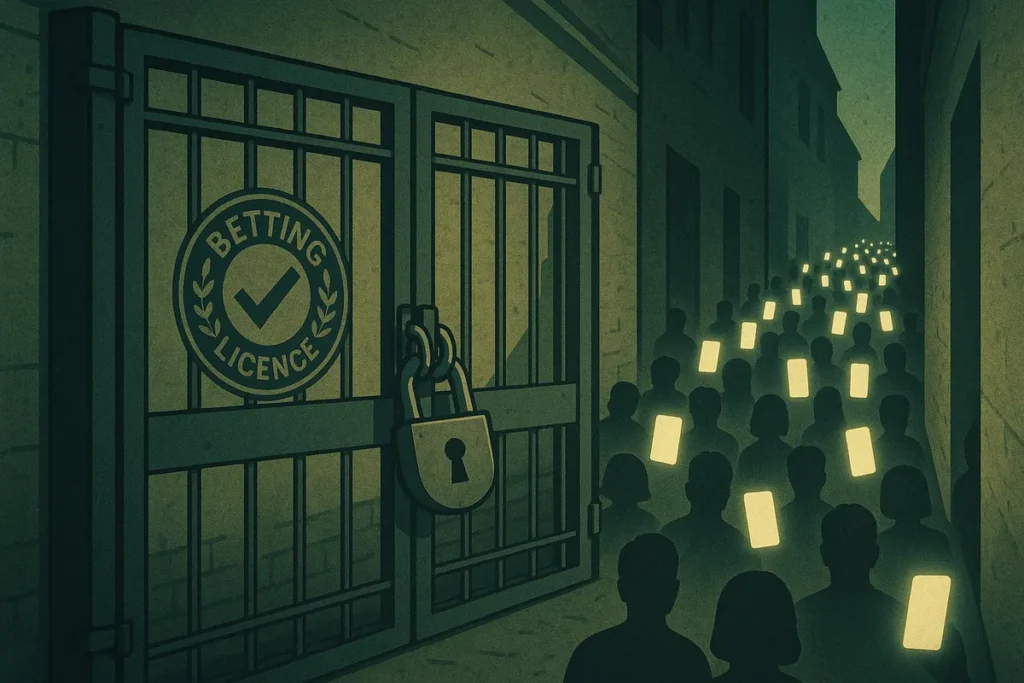



What actually happens to a betting market the day after a government switches it off? Brazil is now the live experiment, and the early numbers are not the ones policymakers hoped for. Within days of the Brazil betting ban being announced, monitoring data showed new illegal betting domains appearing roughly ten times faster than the mid-year baseline. The demand did not disappear. It relocated.
That distinction matters for anyone who writes gambling policy, holds a licence, or simply bets money online. Below, the questions that follow from it, answered in order.
What exactly did Brazil ban, and when?
Brazil prohibited fixed-odds betting and online casino gaming through Provisional Measure No. 1.394/2026, signed by President Luiz Inácio Lula da Silva in late September 2026. The measure ends the regulated market that Brazil had spent years building, including the licensing regime that had brought close to 200 authorised websites into legal operation.
A provisional measure in Brazil carries the force of law from the moment it is published, but it is not permanent: under the constitution it lapses unless Congress ratifies it within the set window. So the ban is operationally real today while its long-term legal status is still contested. That combination, immediate effect plus unresolved legality, is part of why the response has been so messy.
The fiscal side is just as awkward. The proposed 2027 federal budget had already counted on around R$5.3 billion (roughly $1 billion) in betting-related revenue. Remove the licensed market and that line item has to come from somewhere, or not at all.
Why did Brazil ban betting?
The stated motivation sits in the harm column: concern over the scale of household spending on betting, the visibility of gambling advertising, and the exposure of low-income and welfare-dependent households. Those are legitimate worries, and the regulated framework Brazil had been assembling was itself a response to them. The policy question is not whether the harm is real. It is whether prohibition reduces that harm or simply moves it out of view.
How quickly did illegal betting grow?
Fast enough that the timeline is the story. Monitoring platform Bet Legal identified 428 new illegal betting sites between the ban announcement and Sunday, 27 September, which works out at roughly 143 per day. In the days before that, between 21 and 24 September, while Lula was publicly threatening a ban, 246 new illegal sites appeared, about 62 per day. For context, the industry association ANJL had logged an average of 13.7 new illegal domains per day between June and August.
| Period | New illegal domains identified | Average per day |
|---|---|---|
| June to August 2026 (baseline, ANJL) | — | 13.7 |
| 21–24 September (ban threatened) | 246 | ~62 |
| Announcement to 27 September (Bet Legal) | 428 | ~143 |
Read that as a supply signal rather than a headcount of players. Illegal operators saw a market about to be vacated and started building storefronts before the paint was dry on the measure. The demand side was already primed: LCA Consultores estimates illegal operators accounted for 38% to 44% of the Brazilian market even while licensed sites were legal, and in a survey of 2,291 bettors, 77% said they had used a platform involved in illegal practices.
In other words, the black market was not created by the ban. It was handed the rest of the market.
Why do players turn to unregulated gambling instead of stopping?
This is the part that policy models get wrong most often. Prohibition assumes a bettor facing a closed legal door goes home. Behaviourally, a significant share go looking for another door.
Habit and addiction do not respond to legislation
Betting behaviour, especially at the compulsive end, is driven by reinforcement schedules rather than legal status. Someone who has been placing daily in-play bets for two years has an established routine, a bankroll, and in many cases a dependency. A government announcement changes the availability of the legal product. It does not change the urge. For a player already experiencing harm, the ban removes the tools built to help them, which I come back to below.
No legal alternative means no legal ceiling
Where a regulated market exists, it competes with the black market on trust, payment reliability, and the knowledge that a complaint can go somewhere. Remove the licensed option and that competition ends. There is no compliant product left to choose, so the only remaining choice is which unlicensed site to use, a decision most players have no way to evaluate.
Illegal sites look identical to the player
An unlicensed operator runs the same game studios’ content, accepts the same Pix transfers, and buys the same influencer promotion. Nothing in the interface announces the absence of a licence. To a casual bettor, “the site my friend uses that still works” is indistinguishable from the site that was authorised last month, and the switching cost is one tap. Convenience is doing enormous work here, and it all points in the wrong direction.
What risks do players actually take on with black market betting?
The clearest loss is the safeguard stack. Brazil’s regulated framework required facial biometrics at registration, blocked minors, prohibited credit-card funding, and mandated self-exclusion, deposit limits, and daily blocking of Bolsa Família and BPC welfare beneficiaries. None of those obligations touch an unlicensed platform. A self-excluded player can register on an illegal site in two minutes, and a minor faces no meaningful verification.
Beyond harm tools, the practical risks are the ones every player should weigh:
- No payout recourse. If an unlicensed operator voids a bet or freezes a withdrawal, there is no regulator to escalate to and no dispute process with teeth.
- Unverified game fairness. Licensed markets require independent RNG testing and published RTP. Without that, a player has no way to confirm the advertised return to player figure or that outcomes are genuinely random.
- Payment and data exposure. Deposits often route through intermediaries or third-party accounts, which complicates chargebacks and puts identity documents in unaccountable hands.
- Bonus terms with no oversight. Wagering requirements, max-cashout caps, and max-bet rules can be changed or interpreted at will when nobody audits the terms.
- No tax or legal clarity. Winnings from an illegal platform sit outside the reporting framework, leaving the player to carry the consequences.
Worth saying plainly: a licensed operator still holds a mathematical house edge, and no venue, regulated or not, makes betting profitable over time. The difference regulation buys is not better odds. It is verified odds, enforceable payouts, and working brakes.
Can the ban even be enforced?
On current capacity, that is the weakest link. Brazil’s Prizes and Betting Secretariat has four employees dedicated to oversight, previously responsible for monitoring nearly 200 authorised websites alongside thousands of illegal operators. Of the R$1 million allocated in 2026 for betting and lottery regulation and oversight, R$275,600 had been spent.
A team of four was already stretched policing a licensed market with cooperative, licence-holding counterparties. The same team now faces a market composed entirely of operators with no incentive to cooperate, domains that can be re-registered overnight, and mirror sites that reappear faster than blocks are issued. Enforcement capacity, not legal text, is what determines whether a prohibition holds.
What should other regulators take from this?
The transferable lesson is about sequencing, not ideology. Brazil’s experience so far suggests three things worth carrying into any jurisdiction weighing a ban against tighter rules.
- Demand is sticky; supply is fluid. Policy that targets licensed supply without addressing demand relocates the activity rather than reducing it. The 143-domains-per-day figure is the market re-supplying itself in real time.
- Harm tools only exist inside the regulated perimeter. Deposit limits, self-exclusion, advertising restrictions, and welfare-recipient blocks are conditions of a licence. Shrink the perimeter and you delete the tools for the players who need them most.
- Enforcement funding is the policy. A framework is only as strong as the staff and budget behind it. Four oversight officers and a partially spent R$1 million cannot police thousands of offshore sites, and no amount of statutory language substitutes for that.
A harm-reduction approach accepts that some share of the population will bet regardless and concentrates on channelling that activity toward operators who can be audited, taxed, and held to account, while spending real money on treatment, advertising limits, and affordability checks. That is a less satisfying headline than a ban. The evidence coming out of Brazil suggests it is the more effective one.
For players anywhere reading this: if betting has stopped feeling like entertainment, the tools that help are deposit limits, cool-off periods, and self-exclusion, and they only exist on licensed platforms. Support services are available in most jurisdictions, and using them is a far better response than migrating to a site that answers to nobody.
Further reading on this site: our coverage of gambling regulation and licensing frameworks and our guide to responsible gambling tools and limits.

Leave a Reply