

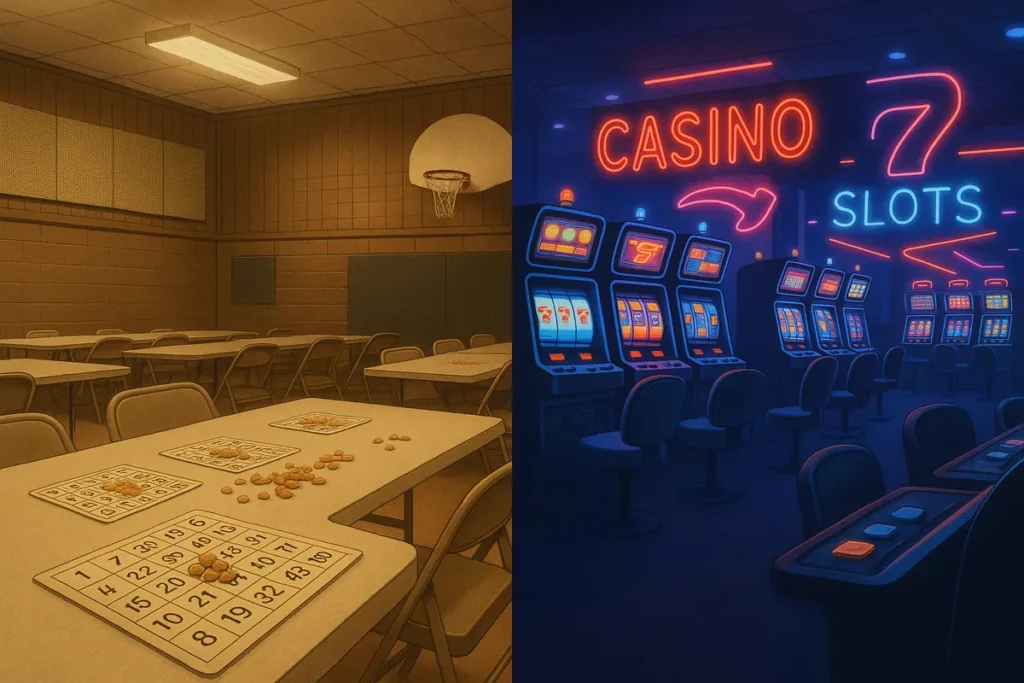
Tribal gaming history, in one line: Native American tribes run casinos on sovereign land because federal law permits it. That sentence is short, tidy, and pointed in the wrong direction. The law didn’t create tribal gaming. Tribal gaming created the law, and it did so with paper bingo cards and kernels of corn.
The industry now clears more than $46 billion a year, a figure CDC Gaming cited in its 2025 look back at the sector’s origins. Trace it far enough upstream and you arrive at a gymnasium in a two-county stretch just west of Green Bay, Wisconsin, on the Oneida Tribe’s reservation. In 1976, two women, Sandra Brehmer and Alma Webster, started a bingo game there. Fewer than 50 players showed up at first.
If you write about or work in gambling, the misconceptions around this story are worth clearing out, because several of them still distort how people read today’s US regulatory fights. Here are the ones that come up most.
Myth 1: Tribal casinos began with the Indian Gaming Regulatory Act
The Indian Gaming Regulatory Act passed in 1988. Bingo on the Oneida reservation started twelve years earlier. The Seminole Tribe of Florida opened its own bingo operation in 1979. By the time Congress wrote the rules, tribes had already been running games for over a decade and had already won the court cases that mattered.
IGRA was a response, not a launch. Congress acted because the Supreme Court had removed most of the legal ground states were standing on, and because nobody in Washington was comfortable with a fast-growing industry operating without a federal framework. That sequence matters: the statute ratified and constrained something that already existed.
The Oneida operation grew the way small businesses grow. Attendance doubled, then filled the gym floor with tables, chairs, a sound system, and eventually electronic boards on the walls. Jackpots reached $100, according to Taryn E. Webster, CEO of Oneida Casino Hotel, and Jessalyn Harvath, the property’s assistant general manager. Nobody in that gymnasium was designing a $46 billion industry. They were funding services.
Myth 2: Bingo was just a placeholder until the slot machines showed up
This one is half right and badly misleading. Bingo was the legal wedge, and it is still load-bearing.
Victor Rocha, conference chairman at the Indian Gaming Association, put it plainly: “When you open these little bingo halls and you’re getting money … it brings the tribes closer to the American dream. Bingo was that first crack in the door that day.”
The crack widened in court. Local jurisdictions in Wisconsin opposed the Oneida games and threatened to close them. “We persisted and battled in the courts and eventually won,” said Webster and Harvath. The 1981 decision in Oneida Indians of Wisconsin v. State of Wisconsin was the turning point, resting on the principle that tribal sovereignty “provides a backdrop against which the applicable treaties and federal statutes must be read.” Attempts to ban tribal bingo in Wisconsin collapsed.
Florida ran the same play and lost it. The state, arguing through Broward County sheriff Robert Butterworth, tried to shut down or limit Seminole bingo, citing fears of organised crime infiltration and the problem of a state being cut out of regulating games inside its own borders. Seminole Tribe v. Butterworth turned on Public Law 280, the 1953 statute that handed certain states criminal jurisdiction over Indian country. The distinction the courts drew, and it is the single most important technical point in this entire history, was between criminal-prohibitory law and civil-regulatory law. Florida did not ban bingo. Florida licensed and regulated it, mainly for churches and charities. A state that permits an activity while regulating it cannot reach onto tribal land to enforce those regulations.
The Supreme Court adopted the same logic nationally in California v. Cabazon Band of Mission Indians in 1987, covering bingo and card rooms. One year later, IGRA.
As for bingo being obsolete: a significant share of machines on tribal floors today are Class II devices, which are electronic bingo games wearing a slot machine’s clothes. The reels are presentation. Underneath, players are competing against each other in a bingo draw. That architecture exists precisely because bingo is the category tribes can offer without negotiating with a state.
Myth 3: Tribes were handed a gambling monopoly as a favour
Nobody granted anything. Tribal sovereignty predates the states that tried to shut these halls down, and every step of expansion was litigated. What tribes have is a jurisdictional position, not a subsidy, and IGRA immediately attached conditions to it.
The motive was never entertainment. “Like many Indian tribes, the Seminoles were seeking new sources of revenue to provide important needed services for our tribal members,” said Seminole Tribe Chairman Marcellus B. Osceola Jr. “Health care, education, housing, senior services, and other needs were on the list and it was our hope that bingo games could help to fund them.” Bingo spread across the country for that reason: tribes needed to pay for basic services, and the game was a mechanism that worked.
IGRA wrote that purpose into law. Net gaming revenue has to go toward tribal government operations and programs, member welfare, economic development, charitable donations, or local government agencies. Per-capita payments to members are allowed only under an approved revenue allocation plan.
Myth 4: Tribal casinos are unregulated
They sit under more layers of oversight than most commercial operators. IGRA created three classes of gaming, and the class determines who signs off on what.
| Class | What it covers | Approval needed | Primary oversight |
|---|---|---|---|
| Class I | Traditional and social games tied to tribal ceremonies | None | Tribe alone |
| Class II | Bingo and games similar to bingo, pull-tabs, electronic aids to bingo, certain non-house-banked card games | No state compact required | Tribal gaming commission with National Indian Gaming Commission oversight |
| Class III | Slot machines, house-banked table games, roulette, sports betting, lotteries | Tribal-state compact, approved by the Secretary of the Interior | Tribe, state under compact terms, NIGC |
That Class II and Class III split is the whole commercial story of the last three decades. Class III is where the money is, and access to it runs through negotiation with a state government, which is why compacts, exclusivity payments, and revenue sharing dominate tribal gaming politics. The National Indian Gaming Commission publishes the federal regulations and annual revenue data if you want the primary material.
Myth 5: Every tribe got rich from this
Revenue is heavily concentrated. Operations within driving distance of large metropolitan populations generate a disproportionate share of the total, while remote reservations with small catchment areas run modest properties or none at all. Plenty of federally recognised tribes have no gaming operation whatsoever. Aggregating everything into one $46 billion number flattens an extremely uneven picture.
Myth 6: This is a land-based story with nothing to say about online gambling
The opposite is true, and it is the reason a 1976 bingo game belongs in your working knowledge of US iGaming.
The legal machinery built around bingo halls is the same machinery now being applied to digital wagering. Florida’s regulated online sports betting market operates through the Seminole Tribe’s compact, on the theory that a bet placed by a phone anywhere in the state occurs where the server sits, on tribal land. That model survived federal court challenges, and other tribes and states have been studying it ever since.
Every current argument, whether it concerns online casino legalisation, sweepstakes-model operators, prediction markets, or who gets to run digital sports betting in a given state, runs into the same question the Butterworth and Cabazon courts answered: where does state authority stop and tribal authority begin? Tribes are not a side interest in US gambling policy. In several states they hold effective veto power over how any new vertical gets structured, and that leverage was earned in a gymnasium with corn kernels and a sound system.
What the pattern actually tells you
The gaming industry’s evolution rarely starts with a statute. It starts with somebody running a small operation in a legal grey zone, a state trying to stop them, and a court drawing a line. Regulation arrives afterwards to manage what already exists. Tribal gaming followed that path, online poker followed a rougher version of it, and the sweepstakes and prediction-market debates now running through US state legislatures are following it in real time.
If you follow this sector, the useful takeaway is procedural: watch the litigation and the compact renegotiations, not the press releases. That is where the next decade of US market structure gets decided.
One closing note on the games themselves. Bingo, slots, and sports betting all carry a built-in house or operator margin, and the long-run maths favours the operator regardless of how any single session goes. Treat gambling as paid entertainment with a cost, set deposit and time limits before you play, and use self-exclusion tools if play stops feeling like a choice.