
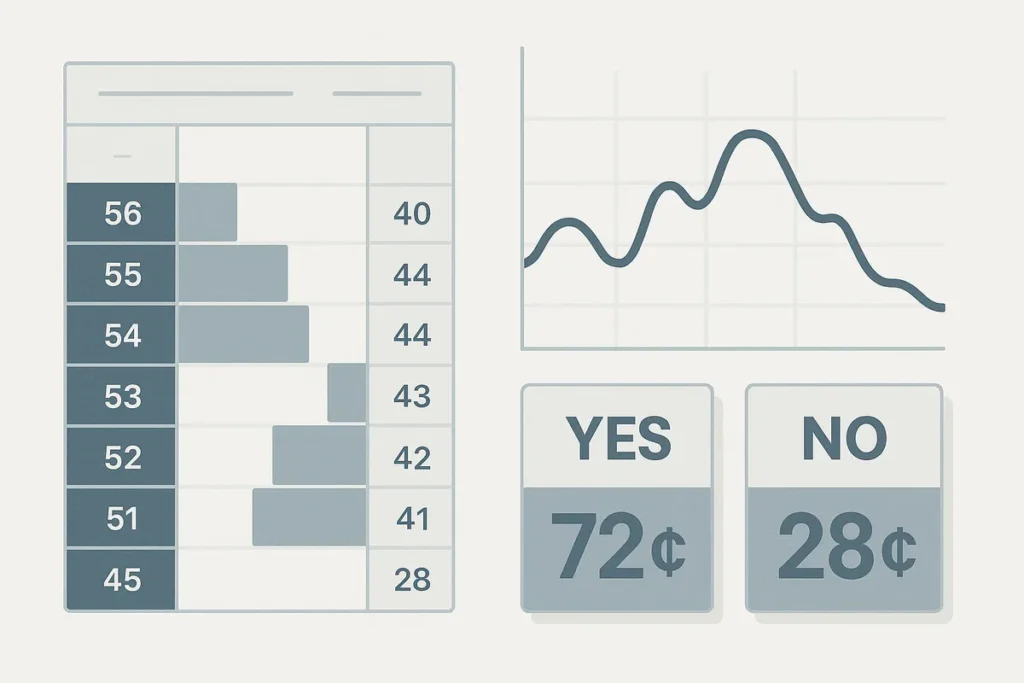
A contract sits at 62 cents. Someone comes in with a large market order and sweeps the offers above it. Thirty seconds later the same contract trades at 65 cents, and every dashboard that tracks the market now says the event has a 65% chance of happening. Nothing happened in the real world. No poll was released, no injury report dropped, no votes were counted. Money moved, and the number moved with it.
That’s the single most useful thing to understand in any prediction markets explained guide: the “odds” you see are a price, set by whoever is willing to buy and sell right now. They are not a probability handed down by an analyst. They’re a market quote, with all the strengths and weaknesses that implies. Deep, heavily traded markets tend to produce prices that track reality closely. Thin ones can be pushed around by a single trader with a bankroll and a motive.
What are prediction markets?
Prediction markets are trading platforms where you buy and sell contracts tied to the outcome of a real-world event. Each contract is a yes/no proposition: a candidate wins a Senate race, a team makes the playoffs, a central bank cuts rates by a certain date. Prices typically run between 1 and 99 cents, and the price of a “yes” contract reads directly as the market’s implied probability.
Platforms such as Polymarket and Kalshi have built markets on everything from mayoral and gubernatorial races to economic data. You aren’t placing a stake against a bookmaker. You’re taking the other side of another participant’s position, at a price the two of you agree on, with the platform matching orders and taking a cut through fees or spread rather than through built-in odds margin.
The practical difference is that a position isn’t frozen once you take it. As long as someone will trade with you, you can sell out early at whatever the market now says the contract is worth. That turns event betting into something closer to trading a short-dated derivative than backing a horse.
How prediction markets work
Event contracts and binary outcomes
An event contract is written to settle at a fixed value: $1 if the stated outcome happens, $0 if it doesn’t. That binary structure is what makes the price readable as a probability. Buy a contract at 62 cents and you’re risking 62 cents to make 38, which is the same as backing something at decimal odds of about 1.61.
Because the outcome is either yes or no, the two sides of the same market should add up to roughly a dollar. If “yes” trades at 62 cents, “no” should trade near 38. Any meaningful gap between them is an inconsistency traders will move to close, which is one of the forces that keeps prices coherent.
Here’s how contract prices translate into the language most bettors already use:
| Contract price | Implied probability | Equivalent decimal odds | Profit on a $100 position if it settles yes |
|---|---|---|---|
| 10c | 10% | 10.00 | $900 |
| 25c | 25% | 4.00 | $300 |
| 50c | 50% | 2.00 | $100 |
| 62c | 62% | 1.61 | $61 |
| 80c | 80% | 1.25 | $25 |
| 95c | 95% | 1.05 | $5 |
Decimal odds here are simply 1 divided by the price, before fees. Note what the last column does to expectations: at 95 cents you’re risking 95 to win 5. High-probability contracts look safe and pay accordingly.
Price formation through trading
Prices come out of an order book, the same structure used in equity and futures trading. Buyers post bids, sellers post asks, and the gap between the best bid and the best ask is the bid-ask spread. A trade happens when someone crosses that spread or when two resting orders match. The last traded price is what gets published as the market’s odds.
Market makers, whether professional firms or algorithmic traders, quote both sides at once and earn the spread for providing liquidity. Their presence is what lets you get filled instantly instead of waiting for a counterparty who happens to want exactly your trade. Where market makers are active, spreads are tight, maybe a cent wide. Where they aren’t, you might see a five or ten cent gap, and the “odds” become a very rough estimate.
This process is price discovery: a lot of people with different information, models and biases pushing against each other until the price settles where the marginal buyer and marginal seller are both satisfied. It works well when there’s real money and real disagreement behind it. It works poorly when there isn’t.
How trading moves implied odds
Implied odds move because somebody consumes the orders sitting in the book. Nothing else is required.
Take a concrete case. Suppose the book on a “yes” contract looks like this: 5,000 shares offered at 62c, 8,000 at 63c, and 20,000 at 65c. A trader wants 30,000 shares and sends a market order. It fills the 5,000 at 62c ($3,100), the 8,000 at 63c ($5,040), then 17,000 of the block at 65c ($11,050). Total cost: $19,190 for 30,000 shares, an average fill of about 64 cents.
Two things just happened. The buyer paid roughly two cents above the quoted price, which is slippage, the real cost of demanding liquidity in a hurry. And the printed odds jumped from 62% to 65% because the last trade cleared at 65c. Anyone reading the market from the outside sees a three-point probability swing driven entirely by one order.
What happens next is the part that matters. If other traders think 65c is too rich, they post new offers at 63c and 64c, the price drifts back down, and the move fades. If they agree the buyer knew something, they pull their offers and bid higher, and the move sticks. Sustained changes in implied odds come from repeated flow in one direction, not from a single clip.
The same logic explains why prediction market odds change without news. Position squaring before settlement, hedging, someone needing cash, a model update at one trading desk. All of it prints as a probability change even when the underlying event hasn’t shifted at all.
Prediction market vs betting: how the mechanics differ
A sportsbook sets a price, builds a margin into it, and takes the other side of your bet. A prediction market matches you against another participant. That single structural difference drives almost everything else.
| Feature | Prediction market | Traditional sportsbook |
|---|---|---|
| Counterparty | Another trader, matched via order book | The bookmaker |
| Pricing | Continuous, set by supply and demand | Set by the operator, adjusted as needed |
| Operator revenue | Trading and settlement fees, spread capture | Built-in margin (overround) on the odds |
| Exiting a position | Sell at the current market price any time | Only if cash-out is offered, at the book’s price |
| Price you get | Depends on available liquidity and slippage | Fixed at the moment you place the bet |
| Stake limits | Limited by market depth | Limited by operator-set maximums |
Neither model is free. A sportsbook’s overround is the visible cost of doing business; on a prediction market you pay through fees, the spread, and slippage on larger orders. What you gain is the ability to trade out, and a price that reflects the whole market’s view rather than one operator’s risk position. What you lose is certainty: your fill price in a thin market can be materially worse than the quote you clicked.
Why volume and liquidity decide whether the price means anything
A prediction market price is only as informative as the money standing behind it. That’s not a caveat, it’s the mechanism. A deep market with tight spreads and constant two-way flow has already absorbed a lot of opinion, so moving it requires real capital and inviting anyone who disagrees to take your money. A market with a few thousand dollars of depth can be nudged several points by a trader with modest size.
Platforms argue that this self-corrects. Kalshi has said its research shows strong correlation between its prices and results, with events priced around 60% happening close to 60% of the time, and that attempts to skew the odds get punished by traders who profit from betting on the correct outcome. That’s the right theory, and in liquid markets it holds up reasonably well. The catch is that pushing a price back only pays if the people with the capital notice and care, which is far more likely in a headline market than in an obscure one.
The misses are instructive. Prediction markets heavily favoured a candidate who went on to lose a primary for Wisconsin governor, a race where conventional polling was also well off. A market at 75% is telling you it expects to be wrong one time in four, and that’s the honest reading even when commentary treats the number as a forecast.
There’s also the insider problem, which the platforms are required under federal law to manage. On 31 August, Kalshi disclosed that it had fined a North Carolina congressional candidate, Republican Laurie Buckhout, and suspended her for three years for trading on her own race. The enforcement is a reminder that participants closest to an event have both the most information and the most incentive to shade the price.
Regulatory status is still contested. Several states have moved to treat these platforms as unlicensed gambling operators, while the platforms maintain they run federally regulated financial markets. Check what’s lawful and available where you live before you trade.
How to read a prediction market without fooling yourself
- Check depth before size. Look at how many contracts sit within a cent or two of the quote. That’s your real available price.
- Treat the spread as a cost. A four cent spread on a 50c contract is an 8% round-trip haircut before you’re right about anything.
- Distinguish a move from a trend. One large order repricing the market means less than steady flow in one direction over hours.
- Read probabilities as probabilities. 85% means roughly three losses in twenty, and those losses will feel like shocks.
- Ignore screenshots of thin markets. A 20 point “swing” in a market with $2,000 of liquidity is close to noise.
Frequently asked questions
How do prediction markets determine odds?
They don’t determine them, traders do. The published odds are the last traded price of a yes/no contract, expressed as a probability. If the contract last traded at 41 cents, the market’s implied odds are 41%. Bids and asks in the order book move the price continuously.
Why do prediction market odds change?
Because buying and selling pressure changes. New information is one cause, but so is a large order clearing out resting offers, market makers adjusting quotes, or traders closing positions. In thin markets, a single sizeable order can shift implied probability by several points on its own.
Is a prediction market the same as a betting exchange?
Mechanically they’re close cousins. Both match participants against each other rather than against a house, and both let you trade out of a position before settlement. Prediction markets frame the instrument as an event contract priced in cents and usually operate under financial rather than gambling regulation.
Can heavy trading actually manipulate the price?
It can move the price, at least temporarily, and that’s the concern regulators and election officials have raised. Whether it stays moved depends on liquidity. In a deep market, other traders are quick to sell into an inflated price. In an illiquid one, there may be nobody on the other side for a while.
A closing note on risk
Every position on a prediction market can settle at zero, and the ability to trade out early makes it easier to churn, not safer. Costs are real even when they’re not labelled as odds margin: fees, spread and slippage all come out of your result. Decide your stake before you open the trade, use deposit and loss limits where the platform offers them, and stop if it’s stopped being a considered decision. If it feels like it’s controlling you rather than the other way round, use the self-exclusion tools or contact a gambling support service in your country.