

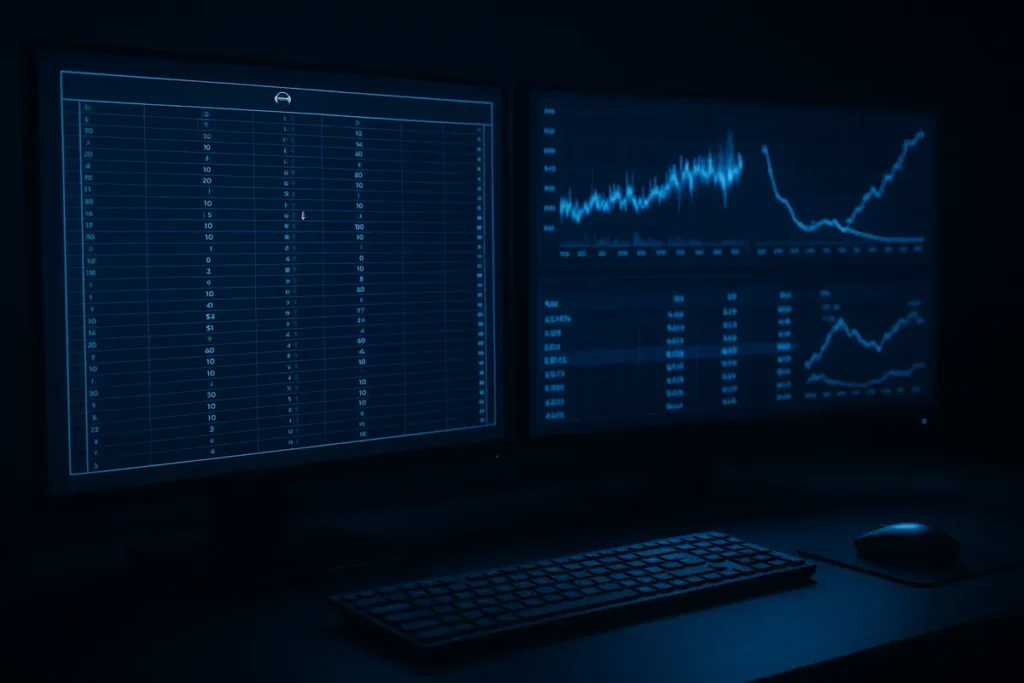
Prediction markets are not a crowd-wisdom alternative to the sportsbook data stack. They run on the same plumbing. When a contract on a fourth-quarter comeback reprices in seconds, that move is not the wisdom of the crowd arriving by osmosis, it is an official data feed hitting a matching engine. Genius Sports has now made that link explicit with the launch of Prediction.com, a site built to aggregate prediction market pricing from multiple venues and overlay it with live sports feeds. The prediction markets sports data pipeline has stopped being a back-office detail and become the product itself.
(If you have seen this described as a “prediction unite” platform, that is a description of the function rather than the name: the product is Prediction.com, and uniting fragmented contract pricing with official in-game data is exactly what it does.)
What Genius Sports’ prediction market platform actually does
Prediction.com is a prediction market affiliate site. Its job is comparison and context, not order matching. According to iGaming Business, the site aggregates pricing and market information from several prediction market operations and layers Genius Sports’ official in-game data on top, so users can watch play-by-play action and dynamic market probabilities in the same view.
Three functions matter technically:
- Like-for-like contract comparison. The same event can be listed on multiple venues with slightly different wording, settlement rules and prices. The site maps equivalent contracts so they can be compared side by side.
- A cross-venue engine for multi-leg positions. Genius describes this as proprietary, and it lets users compare combinations of contracts across exchanges rather than one market at a time.
- Probability tracking in real time. Users follow how implied probabilities move as the event unfolds, against the official data describing what just happened on the field.
It was developed by Legend, the consumer media and technology unit Genius acquired last year for $1.2 billion, and it launched at the start of the NFL season, the peak window for sports data monetisation in the US. Genius’ stated problem to solve is fragmentation: users hopping between platforms to find a price. Sean Conroy, Genius’ EVP of rights and partnerships, framed the launch around integrity as much as pricing, calling robust safeguards “foundational” as the category grows.
How prediction markets use sports data: one drive, end to end
Take a single illustrative sequence to see where the data goes. Say it is a Sunday NFL game, third quarter, the home team trails by four and faces third and seven on their own 40.
- Capture. Official data is collected at the venue under league rights: down, distance, field position, clock, personnel, outcome of the snap. Genius’ business is built on holding and distributing exactly this kind of rights-backed feed, alongside settlement and integrity services.
- Distribution. The feed is pushed to licensed consumers. In August, Genius signed deals with both Polymarket and Kalshi covering real-time event data, league integrity services and streaming. Sportradar announced comparable multi-year deals with the same two venues in June, so both major data suppliers now sit inside the prediction market supply chain.
- Repricing. The quarterback converts for 22 yards. Win probability shifts. On an exchange, nobody “sets” a new price; traders and market makers move their resting orders, and the last traded price on the “home team wins” contract drifts from, say, 44 cents to 52 cents. The data feed is what tells them the state of the game changed.
- Divergence. Venue A’s order book is thin and lags. Venue B, with deeper liquidity, has already moved. For a few seconds the same event carries two different implied probabilities.
- Aggregation. This is the layer Prediction.com adds. Instead of two browser tabs and a mental note, the user sees the contract prices, the divergence and the play that caused it in one place, with the play-by-play stamped alongside the price history.
The important mechanical point: the feed travels faster than the broadcast. Anyone watching on a stream is behind the data, which is why prices can appear to move before viewers see the play. That is not a glitch in the market, it is a property of the distribution chain.
Reading contract prices as odds
Exchange contracts are quoted as a price between 0 and 1, which is the implied probability in cash form. Converting is straightforward, and it is the fastest way for anyone from a traditional betting background to sanity-check a prediction market price. Figures below are illustrative and exclude exchange fees.
| Contract price | Implied probability | Fair decimal odds | Fair American odds |
|---|---|---|---|
| $0.10 | 10% | 10.00 | +900 |
| $0.25 | 25% | 4.00 | +300 |
| $0.50 | 50% | 2.00 | +100 |
| $0.62 | 62% | 1.61 | -163 |
| $0.80 | 80% | 1.25 | -400 |
One structural difference is worth stating plainly. On an exchange, the yes and no sides of a binary contract tend to sum close to $1.00, with the gap being the bid-ask spread, and the venue typically earns from trading fees. A sportsbook builds its margin into the price itself, so the implied probabilities across a market sum to more than 100%. Neither arrangement is free. Costs sit in fees and spreads on one side and in the overround on the other, and over time that cost is what the house or the venue collects.
What unified feeds change about odds compilation
Odds compilation has always been a pricing model fed by data: a model prices the market, a trader or an automated risk engine adjusts for liquidity, exposure and observed market signals. Prediction market prices now join that signal set.
Practically, the shift is that a trading desk gets two independent reads on the same event from the same vendor stack. One is the official data describing the game state. The other is a market-cleared probability from venues where real money has already taken a side. Comparing them is cheap when the timestamps line up in a single stream, and expensive when they arrive from unrelated sources with unmatched contract definitions. That plumbing work, contract mapping and synchronised time-stamping, is the unglamorous core of what this kind of platform delivers.
Two consequences follow. First, price discovery gets faster and more contested; a stale in-play price is easier to spot when an exchange quote sits next to it. Second, integrity monitoring gets a second data source. If an exchange price moves in a way the game state does not justify, that is a flag, and Genius already sells integrity services into both the betting and prediction verticals. CEO Mark Locke has pitched prediction markets as a net benefit for the company precisely because official data, settlement and integrity all get sold again into a new customer base.
Where affiliates and data distributors fit
Prediction.com is, structurally, an affiliate property, and that tells you how the sports data affiliate model is evolving. The old comparison site published prices and hoped for a click. A data-backed version publishes prices plus the official context explaining them, and owns the moment the user is deciding where to act.
For anyone operating in that space, the practical implications are clear enough:
- Owning or licensing rights-backed data is becoming the differentiator, because scraped or delayed prices cannot support real-time comparison.
- Contract mapping is the hard part. Two venues describing the same event with different settlement rules are not the same product, and presenting them as identical misleads users.
- Distribution reach still decides the economics. Genius is combining Legend’s media network with league IP, streaming and integrity services, which is a bundle a standalone affiliate cannot assemble cheaply.
Analyst attention has followed the same logic. Citizens gaming analyst Jordan Bender noted that with the NFL season underway, Genius should benefit from increased spending across both traditional betting and the emerging prediction market industry, and said investors will be watching whether Genius can use Legend’s relationships to capture a larger share of that opportunity.
Common questions
How do prediction markets use sports data?
Licensed real-time feeds tell traders and market makers what has happened in an event, which is what causes contract prices to reprice. Venues also need settlement-grade official data to resolve contracts correctly once the event ends.
Does live data change odds pricing?
Yes. In-play pricing is a function of game state, so a faster or more accurate feed produces tighter, quicker price adjustments. It does not remove the venue’s cost, which stays in the spread, the fees or the bookmaker’s margin.
Is a prediction market contract the same as a bet?
Mechanically they resolve on the same real-world outcome, but the products, regulators and cost structures differ by jurisdiction. Availability and legality of prediction market trading vary by market, so check what applies where you are.
None of this makes outcomes predictable. Better data narrows the gap between a price and the truth; it does not eliminate the cost of participating or the variance in any single event. If you trade or bet on sports, treat it as discretionary spend, set deposit and loss limits, and use the exclusion tools your venue provides.